Tuesday, May 26, 2015

Make Your Business Part Of The Family

We can rely on our families to continuously love and protect each other. A parent’s wisdom has provided generation after generation with sound reason and ample caution through countless decisions and situations. If the idea of hiring your kids or running a family business has been tossed around, stop pitching practices and get in the game.

The dependability, learning experiences, trust, bonding and influence of family values are hard to beat in the business world. If you are considering a family business, you are considering the opportunity to come together and build a supportive environment. Around 35 percent of Fortune 500 companies are family-controlled and represent the full spectrum of American companies from small business to major corporations. Furthermore, family businesses make up 62 percent of the country’s employment. The workday can evolve into a more comfortable place and, with boundaries that separate the professional from personal, after hours can offer security and contentment for everyone.

The IFA’s Educational Foundation’s research shows that over 900,000 franchised businesses provide 21 million jobs and contribute $2.3 trillion to the U.S. private sector economy. With such a variety, many families turn to franchising to grow their brand without the hassle of building a business from the ground up. Brands like Campbell, Ford and even Wal-Mart got its start as family business. They grew to be multi-million dollar companies and left a powerful legacy.

Stop tossing around ideas and get answers! FranNet is waiting to help guide your family to the right business. With 27 years of consulting experience, we’ll help get you closer to your ideal lifestyle. Of the tens of thousands of franchisees that we help get started, about one in four have involved people who wanted to run a family business or hire their children. FranNet has helped around 100 family businesses get off the ground every year.

Entering into a family-run franchise takes some planning. And even if you can address the basic concerns, there are some issues you probably haven't even considered. Call about a free consultation with a qualified and experienced franchise consultant. Make arrangements to speak with one of our representatives today!


Tuesday, May 19, 2015

Still Unsure Of The Millennial Generation?

It’s not set in stone, but generally “millennials” are said to be born somewhere between 1982 and the early 2000's. The exact dates may not be consistent, but the words used to describe this young group of individuals are. Millennials are said to be lazy, narcissistic, living with their parents, incapable of following rules, unemployed, unprepared and (here’s a popular one) in debt. These are just a few descriptions that encompass the people entering or participating in the modern workplace. Also, the US Bureau of Labor Statistics predicts that millennials will make up approximately 75% of the workforce by 2030. 

These harsh accusations are how the professional community imagines this generation. It is understandable why some millennials could feel defensive or angry, yet what should trouble them even more is the truth those words carry.

A study by PNC Financial Services Group confirmed millennials carry an average $45,000 in debt. Pew Research Center’s analysis of the 2012 U.S. Census Bureau data shows 36 percent of the nation’s young adults (ages 18 to 30) live with their parent’s. Forbes explained 68 percent of corporate recruiters say it’s difficult for their organizations to manage millennials because they don’t like red tape, arbitrary hierarchical structures, or being forced to follow a specific process. There is no denying the facts and it’s clear why companies feel the need to arm themselves with articles on “how to deal with them.”

In response, here are a few tips about millennials:
·      Keep an open mind. Not every young person to come before you will have the aforementioned qualities. You might find them to be very open to feedback, tech savvy, creative, flexible and ambitious.
·      Come to terms with the fact that millennials are going to move on. Instead of focusing on stopping them, look for ways to optimize the time they spend with your organization.
·      In a recent Deloitte poll, 70 percent of millennials say they'd reject traditional business to work independently. They are more likely than other generations to study majors related to entrepreneurialism, which shows their entrepreneurial spirit.
·      They look for immediate satisfaction and live heavily in the moment. Instead of trying to change this, integrate their energetic and participatory personality into your workplace.
·      They are optimistic, have high expectations and want to forge their own path. Use their drive and perspective to inspire positive company culture for your business.

The worst thing you could do is fear this generation of excited, hopeful young people. It’s fear and a lack of encouragement, challenges, open minds and lowered expectations that enforce the notion that it’s okay for millennials to have this reputation. It’s not okay.

To the millennials I say: prove you’re a hard worker and strive for success. To everyone else: Let them.

Franchising doesn’t have an age barrier. Out of the thousands of franchises to choose from, there is one that is right for you. Call about a free consultation with a qualified and experienced franchise consultant. 

Monday, December 8, 2014

Networking Your Way to Success

If you’re a business owner or considering business ownership, then it’s likely you know how important networking is to your success. Businesses grow through building relationships and making contacts. So, if you’re not networking, you may be working hard, but not working smart. Let’s take a look at a few tips to help you get started or simply improve your networking strategy.

Networking Goals
The first step in successfully networking is setting goals. These will serve as your framework to take you where you are to where you want to be in creating and nurturing valuable professional relationships. Your networking goals are not set in stone, in fact, you should revisit them often, revise them, scrap the ones that aren’t working for you and set new ones.

Start by making a list of short-term and long-term attainable goals. Now, set a value to them. For instance, your goal is to connect to other business owners. In the short-term, let’s say you want to connect with five different business owners at your next networking event – five connections that you feel you can reach out to for advice, tips, ideas and support. As you reach each of your short-term goals, consider them little “wins,” and let them motivate you as you work toward your quarterly and annual goals.

Networking Tools 
After you have established your networking goals, the next step is to determine how to effectively execute on them. The following are a few tools to consider:

  • Business Cards – Easy to carry and simple reminders to those you meet, business cards not only provide your contact information, but are also a reflection of your business and the quality of your work. Writing quick notes on the back of each business card you receive can also be a great way to remember the connection or serve as a conversation starter on your follow up email to them.
  • Elevator Pitch – This is a critical tool in your networking toolbox. You should be able to describe your business and what you do in a succinct, concise and engaging way in 30 seconds or less. Be sure to tailor your message or tweak it depending on the audience. 
  • Website – If you’re a business owner, you need a website. When potential clients or customers want to learn more about you or your business, one of the very first places they’ll turn to is the Internet. There are a number of tools available to help small business owners get their websites up and running. Which means, you don’t have to be an expert in website design or have a large budget to get started. And, with the content management services available today, it’s easier than ever to create, publish and edit your own site. 
  • Social Media – LinkedIn, Facebook, and Twitter are excellent methods to getting your brand and name in front of hundreds of potential clients and business partners. Link all three and throw in your website and you’ll have a powerhouse of networking tools working for you.

Making Connections
“It’s not what you know, it’s who you know.” This may be an old saying, but it still rings true. Once you’ve developed your goals and compiled your networking tools, it’s time to start making connections.

Networking events are planned for exactly this purpose. So even if walking up to a new person and striking up a conversation is outside of your comfort zone, just know that everyone is there for the same reason you are. Let that give you confidence! Prepare your elevator pitch, bring your business cards and have a few questions in your back pocket to make sure you can keep the conversation flowing. Exchange cards with new connections along with a comment about how you might be able to help them. Be sure to follow up in a few days via email.

Also, consider joining a networking group or groups, which are great for connecting with like-minded individuals. Networking groups can be in-person or online, and both provide you an opportunity to share your expertise and meet and engage with people outside of your normal workday. Find groups that fit you in terms of size, time commitment, industry and goals.

There are a number of tools and tips available to help you network your way to success. From setting goals, to filling your toolbox with effective methods for reaching those goals and adding connections to your professional network, you can make networking a powerful asset to the growth of your business.

Monday, October 13, 2014

Michael Martuza Discusses His New Book, "The Franchise Rules"

Michael Martuza is the owner of FranNet New England and the author of recently released The Franchise Rules: Find a great franchise that ‘fits’ your goals, skills, and budget. As a franchise consultant, Mike works with individuals considering business ownership to match them with franchise businesses in the local market. The book (paperback, ISBN 978-1500615734, $5.99) is the culmination of “rules” he’s gathered over his career to help others discover their ideal business opportunity.

What made you decide to write The Franchise Rules?
While working with clients, I continually come across the same situations and questions. Everyone tends to get hung up on similar issues, so I thought I would write about the underlying guidelines that I recommend clients follow when considering franchise ownership. Not only does it help me as a consultant, but it helps the client be better prepared and educated when they begin their investigation.

Much of the book's content was taken from my franchise business ownership seminars, which feature three basic rules. The book expands on that idea and is really a culmination of all of the rules I’ve figured out over my years of doing this.

How long did the book take you?
Three to four months.

What was your writing process?
I had all of these thoughts and stories I wanted to tell to clients before they began to look at a specific franchise. Prior to outlining the book, I really had to consider how to organize it. How do I make it easy to read and follow?

The book is formulated along the lines of a client’s thought process, beginning with what a client should do or how they should decide if a franchise is the right opportunity. And finally, how best to approach the due diligence process.

I would say 90 percent of the effort was in the organizing and editing. The goal was to provide a lot of great information in a very easy to read book.

How did the title come about?
I was sitting there with this list in my hand thinking about how best to get readers/potential clients to really understand that finding a great franchise is a step-by-step process. It occurred to me that this wasn’t just a list or a process, but for the most part "rules" that should always be followed. I think the title really sums up the contents of this book.

Your first rule, “Don’t Do Anything Stupid,” is pretty blunt. What was the inspiration behind that?
I often talk about people who end up making emotional buying decisions. What I mean are those potential business owners who, without doing any research, think “I want to be in this type of business because …” or “I saw this concept when I was on vacation and it worked there.” I stress that it’s important to inform them so they know what they’re doing and what they’re getting into.

It’s the first rule and phrased that way, because I don’t want readers to rush into a buying decision. Read the book. Read all of the book, and come away better educated on the process before making any decisions.

If there were one thing you would want readers to take away from The Franchise Rules, what would it be?
Utilize experts. They can help the potential franchise owner find the right opportunity; something that will ‘fit’ their goals, skills and budget.

How do these rules come into play when you’re working with clients at FranNet? 
Before a client comes in for a consult they are required (call it homework) to read the book. If they have attended a seminar, I will give it to them in person, otherwise I send it (via Amazon Prime) immediately after a Personal Franchise Assessment (PFA) review call. It takes about two hours to read, so if they are serious about looking at franchises, there is no excuse.

It’s great prep work. Not only does it help educate clients on the process they’re about to start, but it sets expectations and commitments for both parties.

Where can The Franchise Rules be purchased?
The book is available on Amazon, both in electronic ($2.99) and paperback ($5.99) versions.

Monday, October 6, 2014

Five Must Ask Questions Before Investing in a Franchise


There are so many opportunities in franchising that it’s tough to know which ones are worth further investigating and which ones may not be a good fit for your personal and financial goals.  Before you sign anything with a franchisor, here are five questions you must ask (and answer) yourself.
When potential candidates begin talking with franchise systems, they tend to ask pretty standard questions: How much money can I make? How much will I have to spend? How big can I get? Is the franchise territory exclusive? But the deeper you go in your research, the more pointed and detailed the questions get, and they’re critical for a franchisee candidate to ask before signing the franchise agreement.
What does your first-year support look like?
Most good franchise systems, understanding how important the first year of franchise ownership is and how likely a new owner is to struggle, provide extra support and coaching. It could mean the home office assuming all responsibility for marketing, or using customer service reps in a call center to schedule jobs while the franchise owner concentrates on executing the baseline work.
There are all kinds of ways of offering support. But it’s important for any franchisee to know what kind of help they’ll be getting at a time when they’ll really need it.
What are the most common problem areas for franchise owners in your system, and how do you help solve them?
The test of a good franchise system isn’t how well it works when business is going strong. It’s how it helps its franchise owners when they struggle. Even the smartest and hardest-working business owners in rock-solid systems run into challenges every now and then.
When that happens, the franchisor’s operations staff should be prepared to help the owner respond to the problem effectively. In the best systems, they’ve seen and can anticipate many of the pitfalls the business may face.
What kind of insurance should I have?
Don’t overlook this. Some businesses even require certain types of insurance (this would be addressed in the franchisor’s Franchise Disclosure Document).  It’s important to be protected in case of accident or natural disaster, and you need to make sure you’re including the ongoing expense in your business plan.
What kind of ongoing training is available?
Smart franchise systems understand that their franchisees need to keep their skills honed, and franchisees in the system need to stay up-to-date on best practices. Ongoing training opportunities are great for a secondary reason: they send the message that the franchisor cares enough about its franchise owners to give them the tools to succeed.
What’s the relationship among franchisees like?
A culture of cooperation among franchise owners can make the difference between success and failure, and good franchise systems go out of their way to foster good will. Incentives help: franchisors can single out especially helpful veteran franchise owners in internal communications, or they can give monthly “helping hand” awards for the franchisee who most helped first-year owners.
Going into business for yourself requires careful consideration and due diligence – and it’s not a decision to be taken lightly.  But it can be the most rewarding things you can do for your career.  FranchiseWorks.com features some of the best franchises in their respective industry and is a great introduction to those brands.

Wednesday, October 1, 2014

Many Businesses Thrive in All Economic Conditions

If you’re considering franchise business ownership, then you’re most likely aware of the number of options available to you. From quick-service restaurants to IT services and health and wellness businesses, there are more than 3,000 concepts available across more than 90 industries.

Having experienced an economic recession, you may be among the potential business owners thinking, “What about the economy?” Fortunately, the franchise industry is expected to see a continued increase in employment growth and franchise units established for 2014, according to a report released by the International Franchise Association.

Even so, if the economy is on your mind, you should know that there are many businesses that thrive in all economic conditions. So what are they and why is that the case? Below we discuss three areas of franchise businesses considered to be recession-resistant.

Growing markets driven by demographics
Senior care, residential repair and cleaning are just a few of the markets that continue to see steady growth within the franchise industry. What sets these markets apart is how they are driven by demographics.

Take senior care, for example. There are nearly 76 million baby boomers, those born between 1946 and 1964, in the U.S. They make up approximately 24 percent of the U.S. population. As a matter of fact, there’s a person who turns senior age every seven seconds in the U.S. As this generation ages, we will continue to see a growing need for specialized services, care and products. These are needs that, regardless of the economic climate, will need to be met.

Essential services
Essential services are those things that, for the most part, we have to have. These types of services range from the automotive and damage restoration industries to health and wellness, and even hair care.

Let’s look at the automotive industry. From getting to work, to driving to school or dropping the kids off at practice, many of us depend on our cars daily. The best way to keep your car in tip-top shape is to perform routine maintenance, cleaning and detailing.

If you’re thinking, “I can do an oil change myself,” consider that cars today can have fairly advanced issues. Problems with the electrical or fuel system, for instance, may require the expertise of a professional. Plus, many people just don’t have the time, even if they have the knowhow, for DIY. In other words, if you’re a car owner, it’s likely you’ll make needed financial adjustments in order to keep your vehicle up and running.

Businesses that help other small businesses
Franchise opportunities that help other small businesses are things like business coaching, professional consulting, expense analysis and sales training. These types of franchise businesses are great for taking the skills you’ve developed over your tenure and applying them through your own business to help others succeed in theirs.

In an economic downturn, companies may need to re-budget, improve their sales process or decide how best to retain current clients. Often times, additional expertise is needed in these situations. But if you think about it, even in a good economy, these types of business issues are equally important, helping companies focus on business growth or staff development.

There are more than 3,000 concepts to choose from in the franchise industry. We’ve touched on just a few. If the thought of an uncertain economy makes you weary about business ownership, remember that many businesses thrive in all economic conditions.

Friday, August 15, 2014

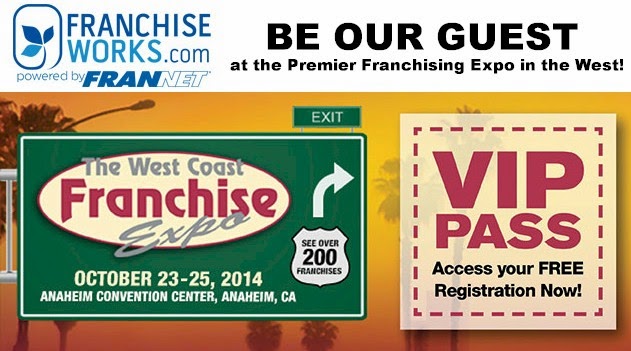
West Coast Franchise Expo Franchise Trade Show, BE OUR GUEST at the Premier Franchising Expo in the West!

FranchiseWorks.com | Franchise Trade Show News: West Coast Franchise Expo, BE OUR GUEST at the Premier Franchising Expo in the West!

October 23-25, 2014 - Anaheim Convention Center - Anaheim, CA
Visit: FranchiseWorks.com @ Booth #: 575

You are invited to be our exclusive VIP guest at the 2014 West Coast Franchise Expo. It's a great opportunity to meet us, and over 200 of the leading franchises, including new and recognized brands. All industries will be represented at all investment levels - starting as low as $10,000, with both full and part-time opportunities.

A franchise allows you to be in business for yourself but not by yourself - with a proven business system that gives you endless support and branding. Don't miss your chance - attend the WCFE and get insight into all the benefits that franchise ownership has to offer.

Register FREE now and get access to:
Industry experts who can help you make the right decisions and discover if franchising is right for you. Choose from over 40 FREE seminars and in-depth symposia - all designed to give you the inspiration, tools and knowledge about the sort of business to suit your dream and lifestyle.
Get legal and financial information & advice.

Register FREE Now for the WCFE!
Use Promo Code: FRANWORKS

Thursday, October 23 - 10:00AM-5:00PM
Friday, October 24 - 10:00AM-5:00PM
Saturday, October 25 - 10:00AM-4:00PM

If you would like more information about owning a franchise, go to http://www.franchiseworks.com.


About www.FranchiseWorks.com

FranchiseWorks.com was established in 1999 with the goal of providing qualified prospective entrepreneurs with the right franchise or business opportunity that meets his or her needs. We showcase hundreds of franchise and business opportunities in a variety of industries including new start-ups to established companies. www.FranchiseWorks.com also has information on franchise financing sources, business opportunity and franchise trade show schedules along with the latest franchise news. For additional franchise information visit http://www.franchiseworks.com or the franchise blog - http://franchiseworksblog.blogspot.com. For more information visit https://secure.events-registration.com/wcfe2014/?source=FRANWORKS.

About FranNet
FranNet is North America’s most respected leader in matching individuals with franchise opportunities. Based in Louisville, Ky., FranNet has more than 80 consultants across North America who use a proprietary profiling and consultative process to determine a business model unique to each client’s goals, skill sets and interests, and have matched thousands of entrepreneurs to rewarding small business opportunities. FranNet has been recognized by Inc. Magazine as one of the top 500 fastest growing private companies in America for the last three years. Visit www.frannet.com.